Cesium Releases in October 2026
In mid-September we announced our second major technology preview focused on design model workflows in Cesium, including the ability to report on the differences between versions of BIM/CAD design models using the Cesium ion API. Cesium ion now also manages source files separately from tiled data.
Our October runtime releases deliver many improvements and fixes, including enhancements for working with the new 3D Tiles 2.0 vector tiles data format in CesiumJS and the ability to use Blueprints to drive styling in Cesium for Unreal.
We will also be hosting two webinars this month: on October 13 we'll be digging into our new vector tiles support, and on October 21 we’ll host our quarterly training and technical exchange for US government employees. We look forward to seeing you there!
We made improvements across Cesium this month. To get notifications about our monthly releases, you can subscribe to the Cesium release roundup thread on our community forum.
CesiumJS 1.146 release
CesiumJS 1.146 is now available. This month's release focuses on improvements to vector tile rendering and extracts CesiumJS's fundamental math, geometry, and time primitives into a separate packages/core workspace to create a lightweight, dependency-isolated package that can be used independently by external consumers, advancing the long-term CesiumJS goal of publishing smaller, more modular packages.
By isolating core functionality with no external dependencies, the new package gives consumers the option to adopt only the core mathematical utilities they need without the overhead of the entire engine, establishing a pattern for splitting out domain-specific code like glTF loading from @cesium/engine for easier updates and testing.
Highlights of the release include:
- CesiumJS now publishes a new package,
@cesium/core, containing the math, geometry, time, and utility classes that were previously part of@cesium/engine. #13805 - Fixed draped polylines rendering at the wrong width at large widths, in both
pixelsandmeterswidth units. #13737 - Added
vectorBlendOptiontoCesium3DTileset, for selecting opaque or translucent modes.blendOptioncan now also be changed after construction onBufferPointCollection,BufferPolylineCollection, andBufferPolygonCollection. This corrects an issue where rendering vector datasets resulted in incorrect blending. #13764 - Reduced load time and memory usage for implicitly tiled tilesets. The app now loads 23× faster and uses 13× less memory on a benchmark large building dataset. #13808
For more details, see the changelog.
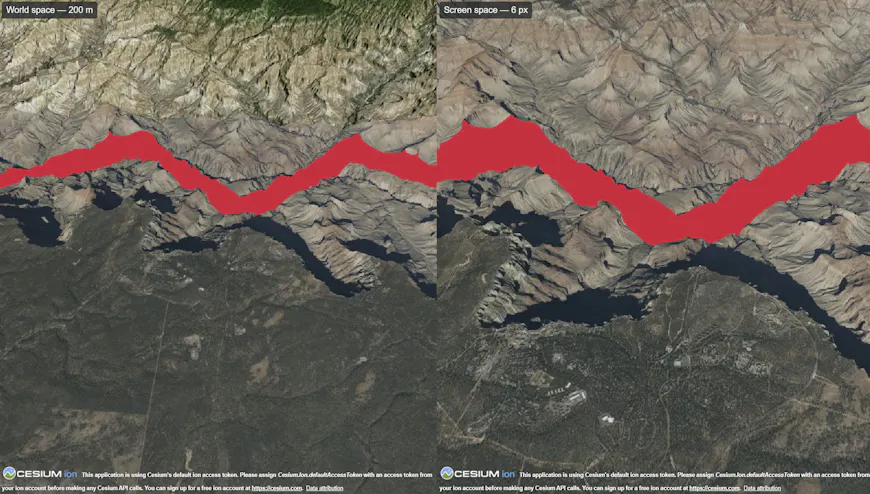
Improved support in CesiumJS for rendering wide vector lines, in both "pixels" and "meters" width units. Data from HydroSHEDS version 1 database from © World Wildlife Fund, Inc. and Cesium World Terrain.
Cesium for Unreal 2.30.0 release
Cesium for Unreal v2.30.0 is now available. Highlights of this release include:
- Added support for styling features in
ACesium3DTilesetwith Blueprints, using a specifiedBlueprintStyleClassthat implementsICesium3DTilesStylingProvideronUCesiumFeaturesMetadataComponent. - Added support for per-element styling on
CesiumVectorTilesRasterOverlay, using either a specified Blueprint class implementingICesiumVectorTilesStylingCallbacksor a C++ class derived fromCesiumVectorOverlays::VectorStylingProvider. - Fixed a bug that made
FCesiumCamerause incorrect parameters when its source was set toECameraParameterSource::CameraComponent.
In addition to the above, this release updates cesium-native from v0.64.0 to v0.65.0. See the changelog for a complete list of changes in cesium-native.
Check the Cesium for Unreal release and the Cesium for Unreal Samples release for the full list of updates.
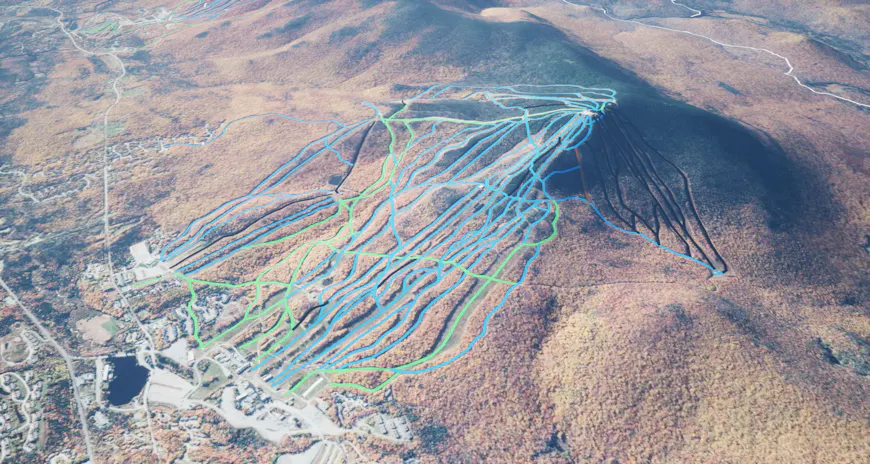
Difficulty of ski runs at Mount Snow, Vermont, USA, visualized in Cesium for Unreal using the CesiumVectorTilesRasterOverlay’s new styling capabilities. Data © OpenStreetMap contributors and OpenSkiMap.org.
Cesium for Unity 1.26.0 release
Cesium for Unity v1.26.0 is now available. Highlights of this release include:
- Added
CesiumVectorPointStyleand apointStylefield onCesiumVectorStyle, enablingCesiumGeoJsonDocumentRasterOverlayto render GeoJSONPointandMultiPointfeatures. - Added support for loading
CesiumCartographicPolygonsfrom polygons in GeoJSON files.
In addition to the above, this release updates cesium-native from v0.64.0 to v0.65.0. See the changelog for a complete list of changes in cesium-native.
Check the Cesium for Unity changelog for the full list of updates, and follow our Cesium for Unity tutorials to get started.
Cesium ion SaaS
- Added the ability to create versions of BIM/CAD Database assets: Cesium ion now supports the re-upload of source files to update a BIM/CAD Database tileset which creates multiple versions of meshes from the database.
- Improved file management: Cesium ion source files and tiled assets are now stored separately in Cesium ion, giving you more control over your storage quota and laying the foundation for new ion workflows. Read more and let us know what you think on the community forum.
- Increase storage quotas: Your storage quota has been doubled! Look for an email from us with details.
- Added a new API endpoint to search for valid CRS codes using geocode-scoped tokens. This enables developers to programmatically discover and validate CRS values when ingesting design models via the API.
- Added new change detection API routes for mesh assets created from the same BIM/CAD Database asset.
Buildings tiler
- Added limited support for CityGML 3.0 generic attributes and boundary surfaces.
Powered by Cesium
Space missions are complex to plan, execute, and communicate to audiences with varying knowledge and interests. To retain engineering accuracy while bringing charts and strings of numbers to life, Blacknight Space’s Event Horizon uses CesiumJS for mission plans and milestones. Views seamlessly transition from Earth centric to Moon centric—and beyond—to meet the needs of complex storytelling. Read about how Blacknight Space brings real-world understanding to complicated narratives with CesiumJS.