Embry-Riddle Uses Cesium Moon to Test EagleCam 2.0 Camera System
What does a Moon landing look like? The student-run Space Technologies Laboratory (STL) at Embry-Riddle Aeronautical University is using Cesium Moon and Cesium for Unreal to test the camera system on EagleCam 2.0 before it flies on the IM-3 mission—and takes the first lunar selfie.
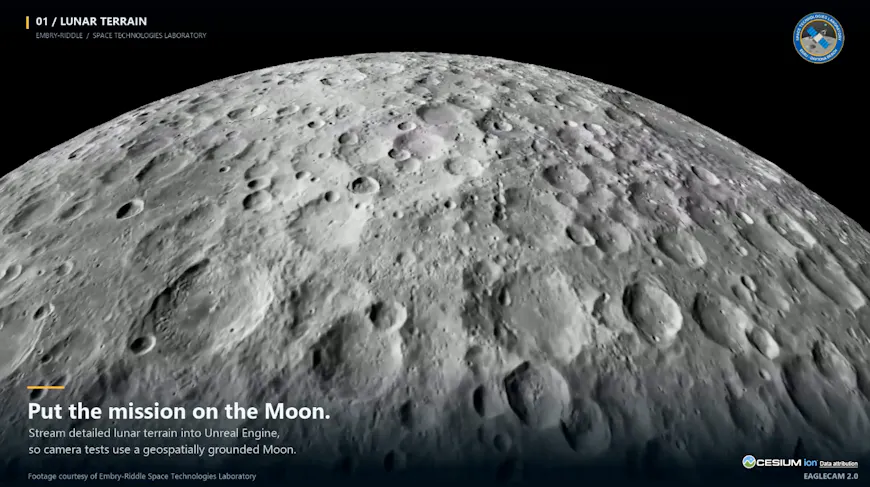
STL used Cesium to build a digital twin of the camera system and large-scale lunar terrain to test settings and learn when to apply adjustments during the mission. Courtesy Embry-Riddle Space Technologies Laboratory.
IM-3 is part of the NASA Commercial Lunar Payload Services (CLPS) program, expected to fly before the end of 2026, and EagleCam 2.0’s job is gathering information-rich images for examination post flight. Instead of building a physical prototype of Intuitive Machines’ lunar lander to assess mounting configurations, spending limited lab budget on the wrong lenses, and imaging ground that doesn’t match that of Earth’s natural satellite, STL used Cesium to build a digital twin of the camera system and large-scale lunar terrain to test settings and learn when to apply adjustments during the mission.
STL develops hardware for commercial missions and research partners and has 15-20 students, undergrads through PhD candidates, actively working on the 10 cm x 10 cm x 10 cm EagleCam. Two to three of those students work on the digital twin. EagleCam is fully student designed, built, and operated.
This is the second time a university has sent a payload to the Moon; the first was EagleCam 1.0.
Work on EagleCam 2.0 began in 2025. The challenges STL saw on EagleCam 1.0—such as predicting lunar lighting, camera placement, fisheye behavior, and coverage—pushed the team to build a digital twin to inform EagleCam 2.0’s life cycle.
EagleCam is fully student designed, built, and operated. Courtesy Embry-Riddle Space Technologies Laboratory.
To see the Moon before IM-3 lands (or even lifts off), STL uses Cesium Moon and Cesium for Unreal. STL streams Cesium Moon—a single complete 3D Tileset composed of precise terrain and imagery from NASA’s Lunar Reconnaissance Orbiter (LRO) program and other sources—via Cesium ion SaaS to the EagleCam digital twin in Unreal Engine. Individual students have their own ion accounts, so they can fuse assets relevant to their parts of the mission, like high-res geoTIFFs of the landing site.
Because Cesium Moon is 3D Tiles, details load based on the active camera instead of forcing the lab to manage one enormous Moon mesh, improving development and navigation.
On top of Cesium Moon, STL added the flight camera's sensor and lens properties, camera position and orientation, realistic exposure controls, roughly 100,000-lux sunlight, and time-based Sun–Earth–Moon geometry from NASA SPICE through the MaxQ Spaceflight Toolkit in Unreal Engine. Unreal produces six render targets per lens, combines them into a fisheye image, and can export image sets for calibration or NASA Ames Stereo Pipeline processing. The team also added orbit trajectories to test maneuvers and observe field of view (FOV) during them.
Building out the digital twin took five to six months, but now Sam Nikolov and his labmates can add lens specs and get renderings in minutes. Cesium Moon provides the mission-relevant geospatial context as an accurate 3D base layer, STL’s camera model generates synthetic stereo images, and the NASA Ames Stereo Pipeline reconstructs terrain from those images, all in Unreal Engine. (STL also uses Cesium for Unity for quick lens-shader prototyping.) Instead of a made-up lens paired with a random spot on the Moon to show what shots might look like, STL gets accurate predictions that support decisions on which lenses and what settings will achieve usable imagery. A 240,000-mile trip is not a simple service call; validating the hardware before launch is vital.
Nikolov, who is dedicated to software development, including firmware on satellite, image processing, and digital twins at STL, explained: “Without Cesium, we would have had to find, process, package, georeference, stream, and render high-resolution lunar terrain ourselves. That would have taken a huge amount of effort and added risk before we even reached the camera problem we actually cared about. Cesium gave our two- to three-person subgroup the terrain, coordinate, LOD, and streaming backbone so we could focus on the lens, calibration, lighting, and operations use case. Cesium ion has never let us down.”
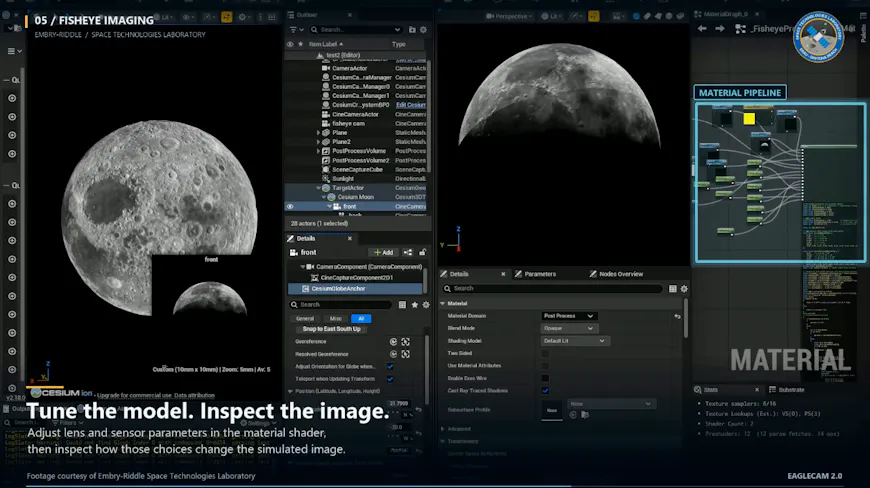
The challenges STL saw on EagleCam 1.0 pushed the team to build a digital twin to inform EagleCam 2.0’s life cycle. Courtesy Embry-Riddle Space Technologies Laboratory.
Nikolov reports that the biggest success is that the simulated images look extremely close to the lab’s real camera references under matched settings. The lab selects a date and time, photographs the Moon outside, considers atmospheric conditions, and compares the result with the simulated view—both visually convincing and correct.
As IM-3 flies to the Moon, STL can consult the digital twin to check expected camera settings and FOV and assess if the returned data will be sufficient for analysis. This means the digital twin supports EagleCam throughout its life cycle: design, hardware selection and placement, mission rehearsal, operations, and post-flight analysis.
Watch Sam Nikolov’s 2026 Cesium Developer Conference lightning talk to learn about the role Cesium plays in EagleCam 2.0.
With Cesium, STL’s EagleCam digital twin enables reduced risk, faster iteration, better design confidence, stronger research output, and a better foundation for future partnerships. It’s also an immersive, intuitive version of the students’ hard work on distortion curves and drawings.
To add Cesium Moon to your Cesium for Unreal projects, follow this guide.