Blacknight Space’s Event Horizon Showcases Mission Plans and Milestones with CesiumJS
Space missions are complex to plan, execute, and communicate to audiences with varying knowledge and interests. To retain engineering accuracy while bringing charts and strings of numbers to life, Blacknight Space’s Event Horizon uses CesiumJS for mission plans and milestones.
Views in Event Horizon seamlessly transition from Earth centric to Moon centric—and beyond—to meet the needs of complex storytelling. Courtesy Blacknight Space.
Event Horizon is an interactive, browser-based 3D mission visualization platform, designed for space operators, engineers, and technical marketers to deliver a dynamic showcase of mission plans and milestones. Teams can confirm trajectories, review events, and educate stakeholders and the public. The application was recently released as an early beta version.
Blacknight Space supports commercial aerospace companies and US defense organizations, aiming to make the industry dramatically more efficient through digital engineering solutions. Blacknight is an Ansys partner for Digital Mission Engineering and shares AGI heritage with Cesium, championing tools for simulations in challenging environments.
“Cesium technology is part of our DNA,” said Nate McBee, VP of product and engineering at Blacknight Space.
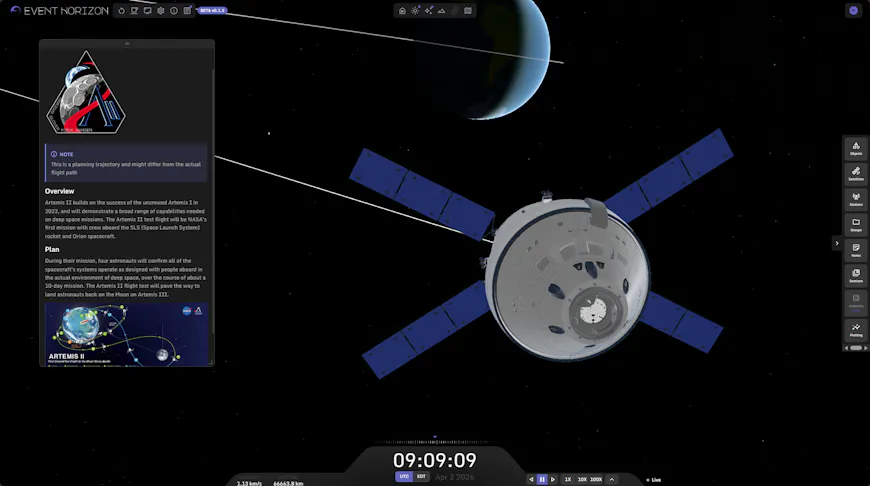
An Event Horizon overview highlights the Artemis II mission. Courtesy Blacknight Space.
Blacknight has been developing Event Horizon on CesiumJS since day one, enabling users across the globe to explore live orbital telemetry, verified flight trajectories, and mission milestones in a browser. (Organizations with sensitive information can employ an on-prem version of Event Horizon.) Users have access to curated data from trusted public satellite databases and can bring their own data—trajectory, attitude, and error ellipsoids, among others.
Event Horizon connects to Cesium ion to provide Cesium World Terrain plus satellite imagery; Google Photorealistic 3D Tiles; and Cesium Moon when mission views bring the user close to Earth or our moon, to ensure efficient streaming of these massive datasets over the web. Users can connect their own ion accounts, too. The app provides models of spacecraft, such as the International Space Station and satellites, and those are rendered as glTF/.glb.
Views seamlessly transition from Earth centric to Moon centric—and beyond—to meet the needs of complex storytelling. Planners and communicators authoring mission narratives with Event Horizon can add saved views and notes to indicate plans and milestones, like stage separations, payload deployments, or rendezvous, in immersive 4D. Blacknight works closely with partners, such as Cesium and COMSPOC, on physics, ephemeris, and rendering, ensuring accurate representation.
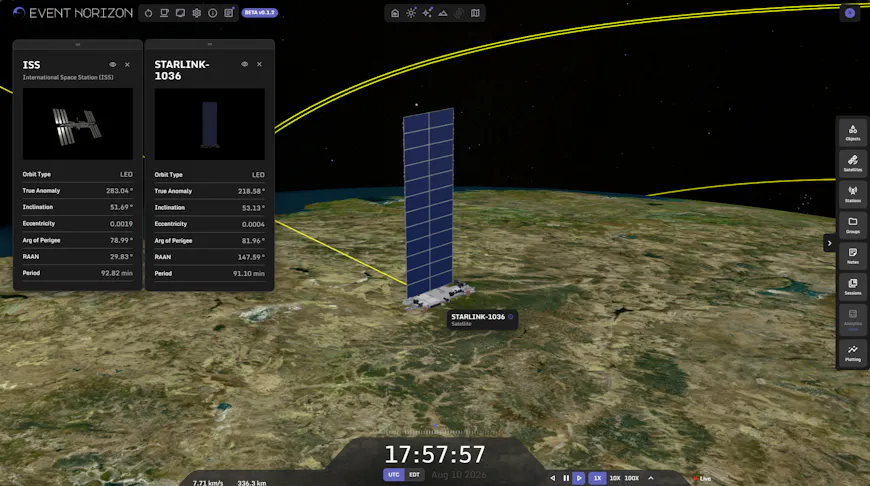
Event Horizon's web interface provides an interactive 3D representation of space operations, mission milestones, and analytics. Courtesy Blacknight Space.
“Our end users and customers always comment on how nice the visualizations look, and, in the space industry, accurate visualization is a critical aspect of mission planning and situational awareness. Cesium helps us paint that accurate picture,” McBee said.
With Cesium’s roots in aerospace and defense, CesiumJS brings out-of-the-box capability to Event Horizon, but its openness and extensibility mean Blacknight can mold it further, implementing unique visualizations and data streams. Blacknight has another advantage, though: two of the organization’s aerospace engineers are Cesium Certified Developers, and McBee estimates they can do in 25% of their time what would require someone else’s full-time efforts. The team gets to their aerospace expertise quickly, while Cesium handles the geospatial context and rendering.
“Being part of a company that's growing the Cesium ecosystem, after helping others share what they can do, shows how the Cesium community drives real progress,” said Kyle Heisey, director of operations at Blacknight Space. Heisey launched and managed the CCD program when he was a Cesium employee.
Watch Klaus Konarkowski’s 2026 Cesium Developer Conference breakout session to learn about the role Cesium plays in Event Horizon.
As Blacknight continues its work on Event Horizon, the team is planning support for unique coordinate systems, relative orbit frames, and mobile performance.
Bring real-world understanding to complicated narratives with CesiumJS and a Cesium ion account.