Unlock Design Intelligence: Expanded BIM/CAD Support and Metadata Queries in Cesium
At the 2026 Cesium Developer Conference, Cesium announced a Technology Preview introducing two key advancements: broader, streamlined support for BIM/CAD formats in Cesium ion and new API endpoints for querying model metadata. These improvements make it easier to access and use design models in digital twins, reducing the required time, effort, and specialized expertise required.
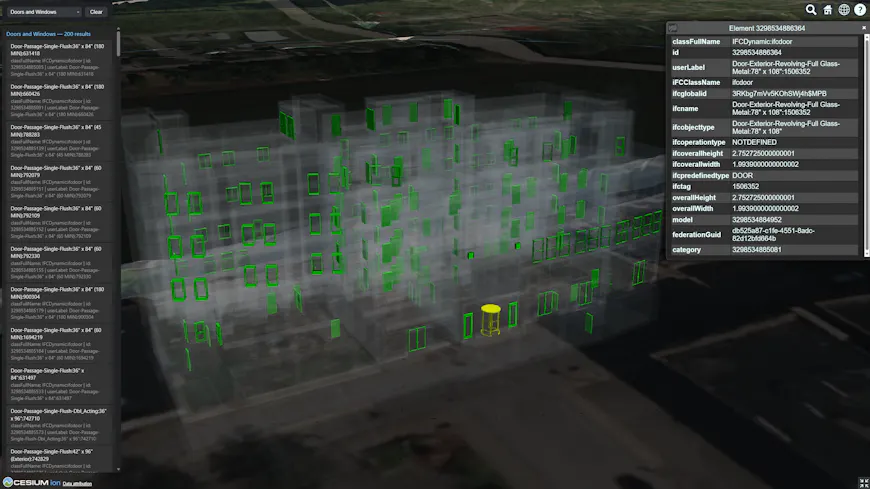
The completed element inspection app built using the Cesium ion Asset Elements API tutorial. This screenshot shows a BIM/CAD building model with the CesiumJS view filtered and styled to display the results of a query for doors and windows. 3D model provided by Autodesk and tiled from the Revit source with Cesium ion.
A new BIM/CAD tiler
We’ve added a new Cesium ion tiler for the most common BIM/CAD formats:
- AutoCAD Drawing (.dwg)
- Revit (.rvt)
- Industry Foundation Classes (.ifc)
- Bentley Design (.dgn)
This tiler and the API endpoints described below are powered by proven Bentley software including iTwin Platform and iModels, now exposed through Cesium ion’s API and user interface.
While Cesium ion’s existing support for tiling IFC and RVT is still in place, the new BIM/CAD tiler offers more convenience—no plugin required for all source file types. It also maintains more model metadata in a backend database that powers our new API endpoints. This unlocks file-based workflows to import design data created with the tools you already use every day.
We’ve also made it easier to properly locate your model in the real world by choosing the right Coordinate Reference System (CRS) when you upload your model—the first of many planned improvements to eliminate the friction that challenges BIM/CAD workflows.
The Coordinate Reference System (CRS) selector makes it easier to correctly locate your BIM/CAD models when uploading them to Cesium ion.
- Many users already share BIM/CAD models with stakeholders using Cesium ion. Our Early Access participants tell us that these changes make it easier and faster: simply upload and tile the source in Cesium ion, add it to a no-code Cesium Story to put it in geospatial context, and share a link with stakeholders.
- Developers of custom applications can leverage Cesium ion’s API as a pipeline to bring BIM/CAD models to their solutions in the open 3D Tiles format, whether they are building with a Cesium client like CesiumJS or Cesium for Unreal, or with other open-source or commercial choices.
Leverage the richness of BIM/CAD models with new APIs
Design models aren’t just geometry; they’re hierarchical, interconnected, metadata-rich datasets. Models uploaded to Cesium ion frequently embed hundreds or even thousands of per-element properties. Models can contain millions of elements, each with hundreds of properties, resulting in the tileset metadata becoming larger than the geometry when streamed. Embedding all properties would negatively impact streaming performance—with most properties never being used downstream.
To avoid wasted runtime memory usage, Cesium ion takes a different approach. The BIM/CAD tiler creates an optimized 3D tileset containing the geometry with key element properties and enables the full element properties to be searched and queried with the new Cesium ion Asset Elements API. The API provides straightforward methods to request metadata about a model’s elements by type. For example, in the building model application shown above, the developer queried for information about the model elements with types window and door.
As we expand metadata support with the new BIM/CAD Tiler, we’re actively seeking feedback from early adopters on whether they also need options to embed custom, user-selected metadata or export it for use in applications that can’t access ion’s API.
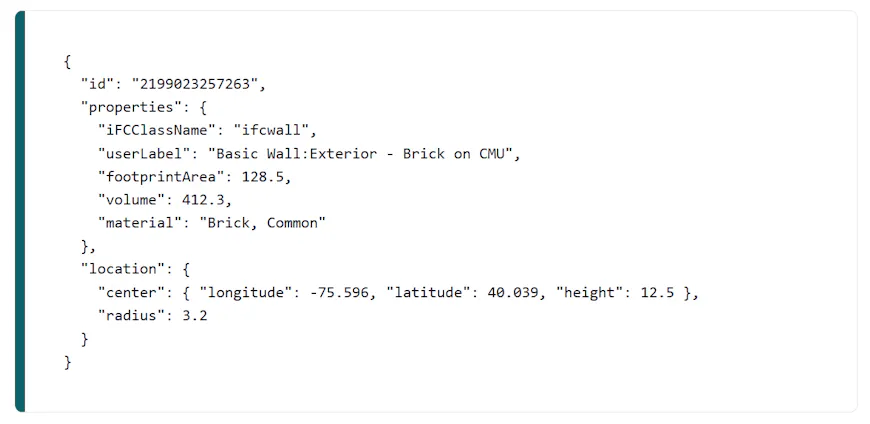
Using Cesium ion’s REST API, developers can access the metadata properties for elements in a 3D model, returned as JSON as shown here for visualization and interactions. See the Cesium BIM/CAD Data Guide to learn more.
With CesiumJS and other runtime engines, developers can use the API to build applications for model stakeholders, engineering teams, and other infrastructure professionals to visualize and interact with model metadata in high-precision, element-specific workflows.
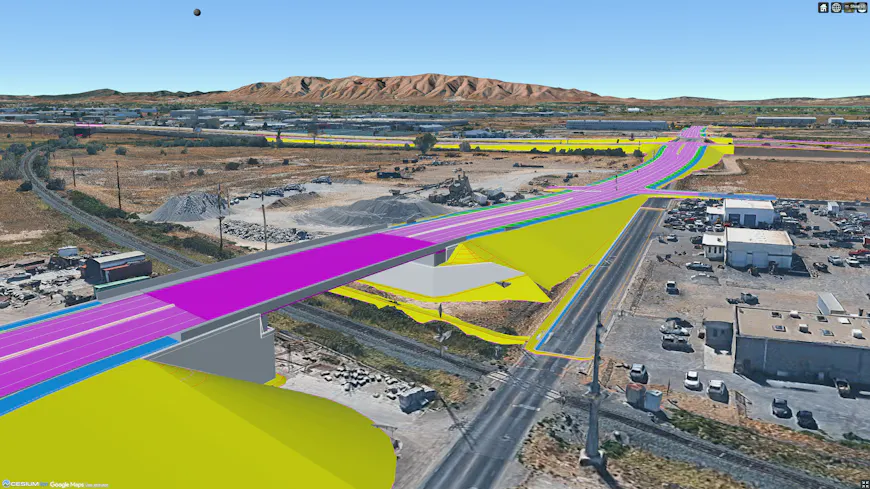
The Utah Department of Transportation (UDOT) is a leader in digital delivery workflows for massive, multi-phase projects like this overpass. The 3D model provided as Bentley OpenRoads Designer (DGN) files and tiled with Cesium ion. Data courtesy of UDOT.
For example, U.S. state Departments of Transportation are creating purpose-built digital delivery applications like a Project Corridor Viewer, transforming transportation projects into immersive, interactive 3D experiences. These viewers bring engineering data into a Cesium-enabled geospatial context and empower teams to query and search to visualize and analyze the information they need throughout the entire infrastructure lifecycle, from planning and design to construction and operations.
"UDOT has been the pioneer for digital delivery for the DOTs. Now the question isn’t what’s possible...it’s what’s next? As we continue to push beyond models into connected data and digital twins, we’re looking for the next breakthrough that moves our industry forward."
— Nicole Williams, Vice President Kimley-Horn

At the 2026 Cesium Developer Conference, Nicole Williams of Kimley-Horn explained how she wrote the playbook for state DOT digital delivery—from the first 3D model used as a legal construction document to more than 15 paperless projects. She demonstrated that the design-to-operations data gap is a pipeline problem solved by bringing geospatial and engineering together on one platform.
We can’t wait to see what users build with these features, but we’re just as excited about what’s coming next.
Throughout this summer and fall, look for:
- Ongoing improvements to the tiling pipeline speed and quality for BIM/CAD models.
- The ability to update BIM/CAD models in Cesium ion while maintaining access to past versions.
- Change detection APIs to query for the differences between model versions. Visualize what changed over time to power workflows for revision review, optioneering, and communicating changes across distributed teams.
- More georeferencing improvements to accurately locate models in the real-world faster, more intuitively, and with fewer extra steps.
- Clipping tools in Cesium ion (server-side) and in CesiumJS and Cesium for Unreal (client-side). We are working to eliminate the painstaking steps often required to capture precise model footprints that enable clean visualization of a model placed in real world context.
- Precise mouse snapping to model geometry to enable more accurate interactivity, such as picking elements, selection, calculations and visualization of points of measurements on design models streamed from Cesium ion. These enhancements are essential to the design review that is part of digital delivery workflows.
- API-enabled filtering for easier and tighter control of what data is displayed in your applications.
After attending the 2026 Cesium Developer Conference keynote on Cesium’s new BIM/CAD capabilities, Dakota Mohan, Digital Delivery Lead at infrastructure design and engineering firm JMT, rapidly built a prototype of design models from Bentley Digital Cities Infrastructure Cloud streamed into CesiumJS. The app enables interactive exploration of a roadway corridor and IFC bridge model with advanced visibility controls, element queries, and attribute-based filtering of construction details like rebar. Dakota presented his work on the very next day at the conference! Video courtesy of Dakota Mohan and JMT. Read more on LinkedIn.
We’re grateful for the feedback we’ve already received from Early Access users of the BIM/CAD tiler and our new API endpoints. We’d love to hear from you too; let us know what works for you (or what doesn’t!). Which of the coming features are most important to you? What will you build as we continue to lower the barrier to entry?
Join the conversation on the Cesium Community and help shape the future of BIM/CAD workflows on the open 3D geospatial platform.

At the 2026 Cesium Developer Conference, Dakota Mohan of JMT discusses his rapid experimentation with Cesium’s new BIM/CAD support with Shehzan Mohammed, Head of Product Management for Platform at Cesium, a Bentley company.