TruGolf Delivers Real-World Golf Courses on Demand with Cesium for Unreal
TruGolf is pursuing an ambitious goal: make it possible to virtually play every golf course in the world. Delivering thousands of real-world golf courses requires building and serving an enormous catalog. With Cesium for Unreal, TruGolf can place each course in its real-world location, surround it with recognizable scenery from global datasets, and deliver it at runtime without requiring players to download a massive library.
This small selection of courses in TruGolf’s extensive library showcases the way custom-built golf courses fuse with global datasets to create a realistic experience. Courtesy TruGolf.
TruGolf, a pioneer in indoor golf technology, has offered a virtual playing experience since 1983. This year, E6 Golf 2026 by TruGolf has grown its offerings by 50% and now includes over 15,000 real-world courses on demand. As the number of available courses has grown, players have responded: golfers this year have explored more than four times as many different courses as they did a year earlier.
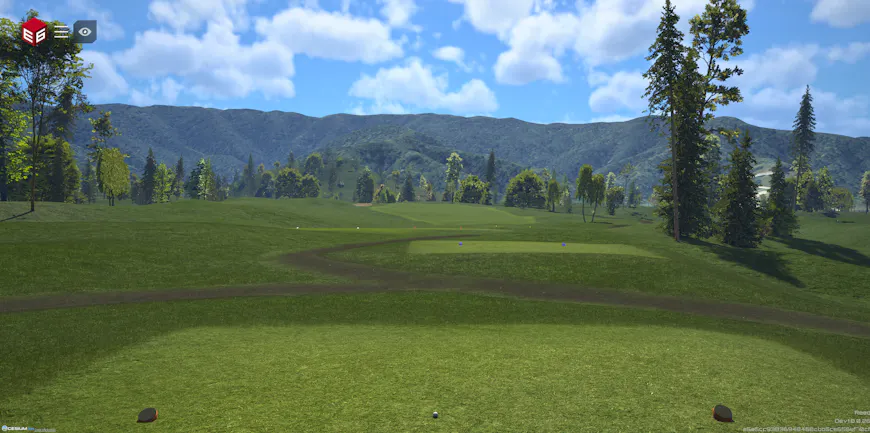
In E6 by TruGolf, Google Photorealistic 3D Tiles and Bing Maps imagery provide the surrounding scenery that helps players have a truly immersive experience. Courtesy TruGolf.
They have custom built each course using a combination of public and high-resolution private datasets, all processed and smoothed to support accurate ball physics for gameplay. The immersiveness of the experience comes from placing these courses in their real world locations so players see surrounding imagery from global datasets served by Cesium ion, including Google Photorealistic 3D Tiles and Bing Maps imagery. Cesium’s coordinate systems allow TruGolf to place each dataset in its correct location in the world. TruGolf further layers the experience with auto populated vegetation and with adjustable controls to set the time of day, weather, and atmospheric effects. Bringing all these elements together creates an immersive experience that allows users to feel like they are actually on site.
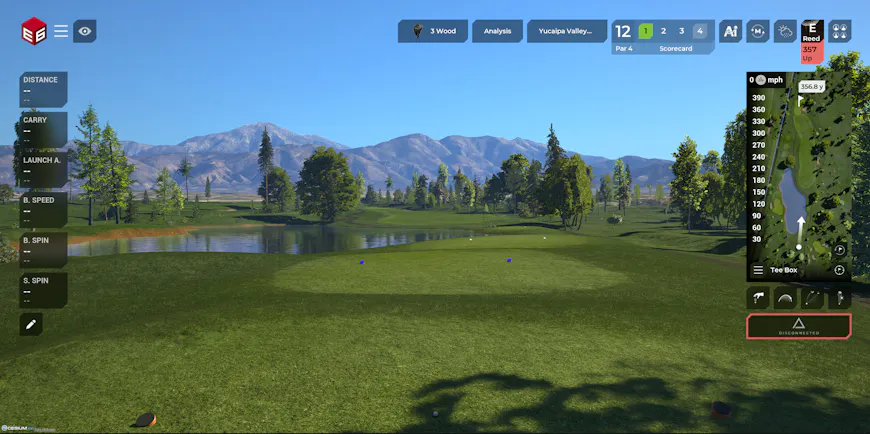
E6 by TruGolf generates each course on the fly at runtime. By generating courses dynamically, TruGolf can provide immediate access to a large catalog of courses without requiring massive downloads. Courtesy TruGolf.
Despite this extensive collection, users don’t have to download the entire library. All courses are generated on the fly at runtime, reducing bandwidth and storage costs and enabling scalability. Golfers jump seamlessly from one course to another and begin playing almost immediately, despite the extensive course library available to them. The ability to deliver only the data needed for the current experience helps keep the application responsive while supporting a virtually unlimited catalog of content.
“Golfers judge a simulator by two things: how many courses they can play and how real those courses feel. Delivering each course on demand lets us keep adding to a library of more than 15,000 courses without requiring massive downloads. Cesium surrounds every one of those courses with the real world with stunning accuracy. That combination is what lets the platform scale."
– Jake Johnson, VP Software, TruGolf
E6 by TruGolf is compatible with numerous hardware systems, which measure a player’s swing using camera or LiDAR sensors that calculate spin, speed, and impact. Taking those inputs, the simulator offers an accurate, immersive simulation that also provides detailed analytics to help players improve.
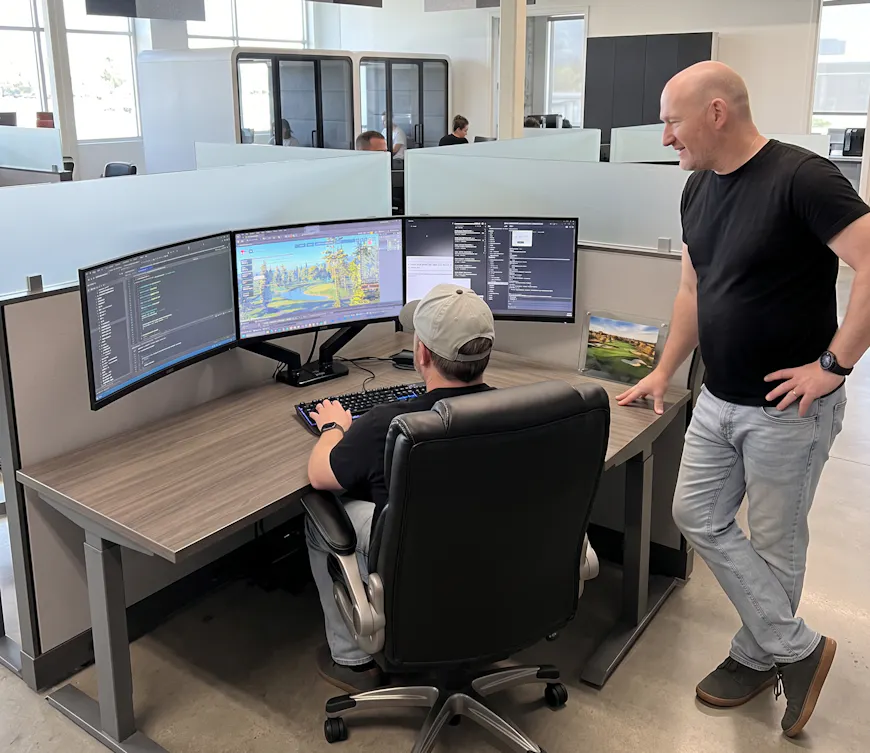
Using Cesium’s globe and coordinate systems in Unreal Engine allows TruGolf to place each course in its correct location in the world and bring in real-world data from that area. Courtesy TruGolf.
Used in restaurants and other hospitality venues, at dedicated golf centers, and in home game rooms across the United States, E6 by TruGolf uses Cesium to provide global context for each course. To transform your simulator from an approximation to a geospecific experience with real world locations, try out Cesium for Unreal.