Introducing 3D Gaussian Splats with Hierarchical Level of Detail Using 3D Tiles
3D Gaussian splats are now available in the Cesium and 3D Tiles ecosystems, including CesiumJS, Cesium for Unreal, and Cesium ion. This integration enables developers to stream and visualize high-fidelity, photorealistic 3D content that captures the real world with unprecedented detail. By leveraging 3D Tiles as a spatial index and glTF as the payload, massive 3D Gaussian splat datasets can now be streamed with level of detail (LOD), ensuring high performance from city-scale environments down to sub-centimeter details.
3D Gaussian splatting is an efficient radiance field reconstruction method that converts 2D images into a sparse cloud of volumetric 3D Gaussians. Unlike traditional photogrammetry, which often struggles to represent thin or complex structures, 3D Gaussian splats excel at preserving visual fidelity for cables, power lines, vegetation, and reflective surfaces by creating a point cloud of soft, rounded shapes of the subject, with each point defined by properties including position, orientation, color, and opacity. This technique uses spherical harmonics to support view-dependent lighting, allowing for realistic specular reflections and anisotropy that traditional reality meshes cannot easily replicate.
3D Gaussian splatting provides significant advantages for industries requiring high-fidelity reality capture and photorealistic digital twins, including infrastructure monitoring, telecom tower maintenance, and electrical utility and substation inspections—plus the built environment, such as in real estate, where traditional mesh and point cloud methods often have limits. Beyond industrial applications, we see 3D Gaussian splats being adopted in media and entertainment to capture challenging visual details like reflections, semitransparent materials, and fire. 3D Gaussian splats are expected to play a key role in long-term asset monitoring and situational awareness, enabling users to track changes in the natural and built environment over the entire life cycle.

3D Gaussian splats enable high-fidelity accurate visualizations of thin-and-long assets like cranes, building materials, power stations, and cell towers. This crane is depicted with Cesium for Unreal.
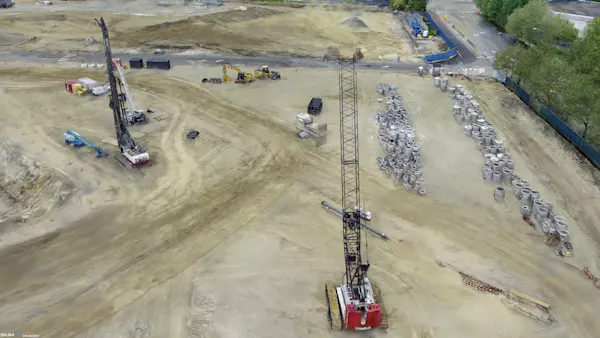
3D Gaussian splats enable high-fidelity accurate visualizations of thin-and-long assets like cranes, building materials, power stations, and cell towers. This scene is depicted in CesiumJS.
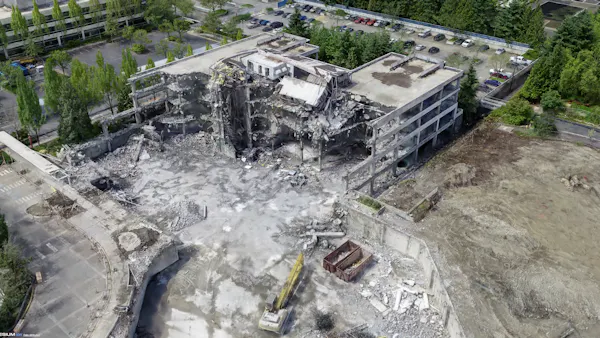
3D Gaussian splats enable high-fidelity accurate visualizations of thin-and-long assets like cranes, building materials, power stations, and cell towers. This scene is depicted in CesiumJS.
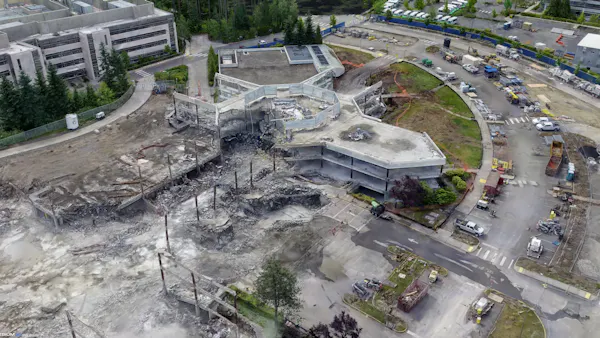
3D Gaussian splats enable high-fidelity accurate visualizations of thin-and-long assets like cranes, building materials, power stations, and cell towers. This scene is depicted in CesiumJS.
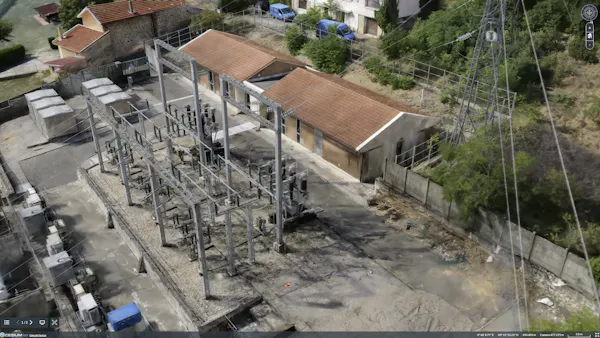
3D Gaussian splats enable high-fidelity accurate visualizations of thin-and-long assets like cranes, building materials, power stations, and cell towers. This scene is depicted in CesiumJS.
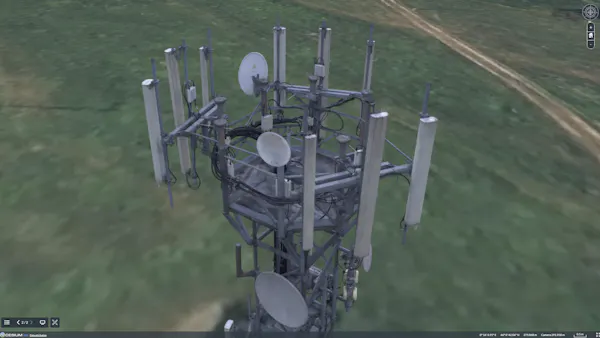
3D Gaussian splats enable high-fidelity accurate visualizations of thin-and-long assets like cranes, building materials, power stations, and cell towers. This scene is depicted in CesiumJS.
Standardizing 3D Gaussian splats in glTF with SPZ compression
To ensure 3D Gaussian splats are interoperable across platforms, we have collaborated with Khronos, Open Geospatial Consortium (OGC), Esri, and Niantic Spatial to integrate this new graphics primitive into the glTF 3D asset standard. This effort centers on two new extensions: KHR_gaussian_splatting and KHR_gaussian_splatting_compression_spz. The base glTF extension defines how splats are stored as point primitives, which allows for a graceful fallback to sparse point clouds in renderers that do not yet support rendering 3D Gaussian splats.
"The geospatial community has been the catalyst for bringing Gaussian splats into glTF as an open, interoperable primitive, and the close collaboration between Cesium, Esri, and Niantic Spatial at OGC and Khronos is a model for how new rendering techniques should enter the industry: quickly, openly, and with broad cross-community backing from day one. Ratification at Khronos elevates Niantic's SPZ compression from an open-source project into a royalty-free open standard, providing the IP certainty that enterprises and platforms need to adopt it at scale."
—Neil Trevett, President, Khronos Group
A major challenge for 3D Gaussian splats has been their massive file size, which can hinder efficient streaming. To solve this, we adopted the SPZ compression format, an open source solution provided by Niantic Spatial. SPZ uses advanced quantization techniques and gzip to compress splat data by up to 90% compared to standard PLY files while maintaining visual fidelity. This format is particularly effective at handling spherical harmonic data for specular lighting. Furthermore, the recent SPZ 2.0.0 release introduced improved rotational accuracy for linear geospatial features—such as antennas and power lines—by encoding rotations as normalized quaternions.
3D Gaussian splats will be added to 3D Tiles as part of the proposed 3D Tiles 2.0 OGC community standard.
"The Open Geospatial Consortium (OGC) endorsed 3D Tiles as a Community Standard because it offered a compelling ability to distribute 3D content to users in a performant manner that also adhered to best practices in handling geospatial information and accuracy. This same approach to provide Gaussian splats via glTF and 3D Tiles ensures that the information portrayed by those Gaussian splats is in the right place and provides meaningful context for geospatial analysis."
— Scott Simmons, Chief Standards Officer, OGC
Creating 3D Gaussian splats using Cesium ion
With the integration of iTwin Capture technology into Cesium ion, the platform provides an end-to-end pipeline for reality modeling, including the creation of 3D Gaussian splats with LOD. Users can upload source photos directly to Cesium ion, which will automatically reconstruct a 3D Tileset as a mesh, point cloud, or 3D Gaussian splats.
To accommodate different development needs, these workflows are accessible through both the Cesium ion web interface and via REST APIs, enabling everything from manual one-off uploads to fully automated, high-scale production pipelines. Once tiled, these splats are georeferenced, allowing them to be instantly combined with global datasets like Cesium World Terrain or Google Photorealistic 3D Tiles for full geospatial context.
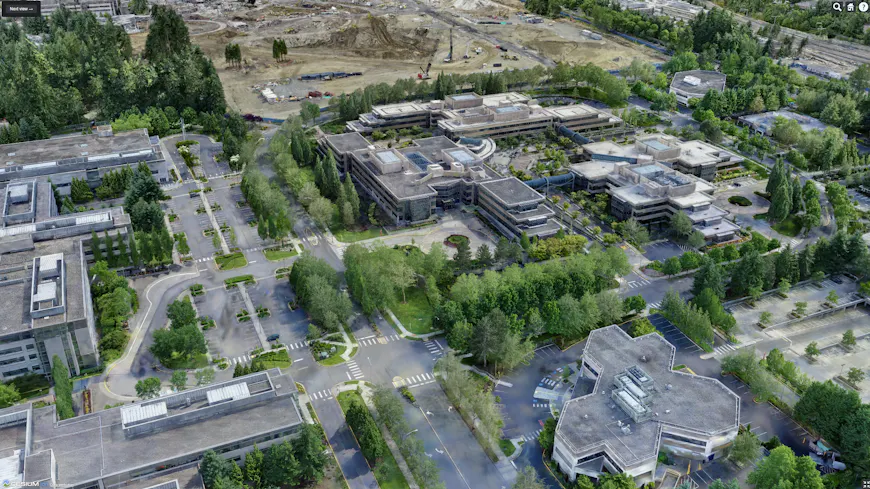
3D Gaussian splat tileset of Microsoft Redmond Campus, as viewed in CesiumJS. Captured in partnership with Bentley Systems. This tileset uses 20,169 photos (427.7 gigapixels, DJI FC6310 camera) and covers an area of about 3.7 sq km, with mean ground sampling distance 3 cm. The reconstruction is 110 million splats.
Streaming to CesiumJS, Cesium for Unreal, and more
CesiumJS now supports 3D Gaussian splat tilesets. The implementation uses specialized shaders for volumetric rendering and high-performance sorting using WebAssembly for increased performance. Developers using CesiumJS can build high-fidelity digital twin applications leveraging 3D Gaussian splat tilesets in conjunction with previously supported data types.
"The barriers to working with Gaussian splatting continue to fall. With a glTF extension and LOD support now part of 3D Tiles, developers can increasingly work with splats within familiar tools and workflows. Gaussian splats are quickly becoming a professional, scalable medium for delivering lifelike 3D on the web."
— Michael Rubloff, Founder and Managing Editor, RadianceFields.com
For developers building immersive experiences with game engines, Cesium for Unreal now supports 3D Gaussian splat tilesets, as well. This enables the integration of massive 3D Gaussian splat dataset rendering into the Unreal Engine ecosystem with the ability to stream 3D Gaussian splats with LOD directly from Cesium ion. In addition to Cesium for Unreal, we plan to add support to Cesium for Unity and other runtime engines based on community feedback. By standardizing splat delivery through 3D Tiles and glTF extensions, we’re ensuring that these assets remain interoperable across platforms as the field of neural rendering evolves.
Getting started with 3D Gaussian splats
Upload your own photos to Cesium ion by signing up for a free community account. You can try out live examples in the Cesium Sandcastle or start building your own reality models today.