Blenheim Palace Performing Smart Conservation with Cesium
Blenheim Palace, a UNESCO World Heritage Site and one of England’s most iconic estates, faces a monumental challenge: maintaining a 300-year-old building that welcomes over one million visitors annually, while also serving as a lived-in residence.

Blenheim Palace, a UNESCO World Heritage Site and one of England’s most iconic estates. Courtesy Blenheim Palace.
To keep up with these challenges, Blenheim Palace has invested in an IoT sensor network that monitors all sorts of data from the building, such as temperature, humidity, CO2 levels, and footfall.
The data, pouring in from over 30 platforms, became too much for their building management system (BMS) to take in and ended up siloed, often buried in folders. Maintenance teams, facing restoration costs of £4 million a year and overwhelmed by the sheer volume of data, found it nearly impossible to get a comprehensive picture of the state of the palace, let alone plan for the future.

At 300 years old, Blenheim Palace requires constant maintenance and reconstruction work. Courtesy Blenheim Palace.
That’s all changed now that they’ve developed a digital twin of Blenheim Palace, built with Cesium, that provides a single source of truth for the state of the palace. IoT sensors feed real-time alerts into a unified platform, allowing maintenance teams to visualize issues in context, plan restoration work proactively, and even receive automated notifications when environmental thresholds are breached.
Massive models made usable with 3D Tiles
Blenheim Palace’s digital twin was born with the announcement of the Cesium Design Tiler and Add-In for Autodesk Revit. The team at Blenheim saw that the 3D Tiles open standard would allow them to efficiently stream heavy Revit files into a lightweight environment, providing a frontend through which they could access all of the IoT data they were collecting.
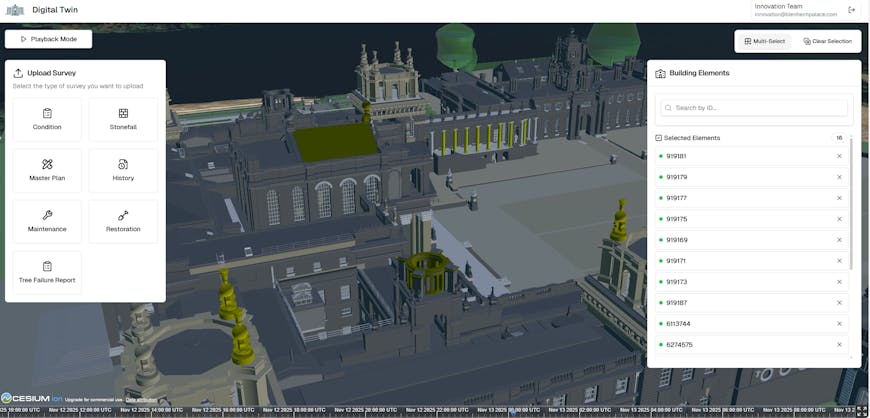
Loaded in CesiumJS, the interactive palace model streams smoothly despite its size and complexity thanks to 3D tiling via the Cesium ion for Autodesk Revit Add-In. Courtesy Blenheim Palace.
In partnership with the Heritage Innovation Laboratory Oxford and Oxford Brookes University, Blenheim’s team worked to make their BIM model the foundation of a digital twin. They sliced their architectural model into over 14,000 individual elements, each tied to metadata: material type, historical repairs, risk assessments, etc. Then, using the Revit add-in and the Design Tiler in Cesium ion, they tiled the model into 3D Tiles. Now with a model that retained all the detail and metadata of the original but tiled for smooth navigation, they loaded the 3D Tileset into CesiumJS.
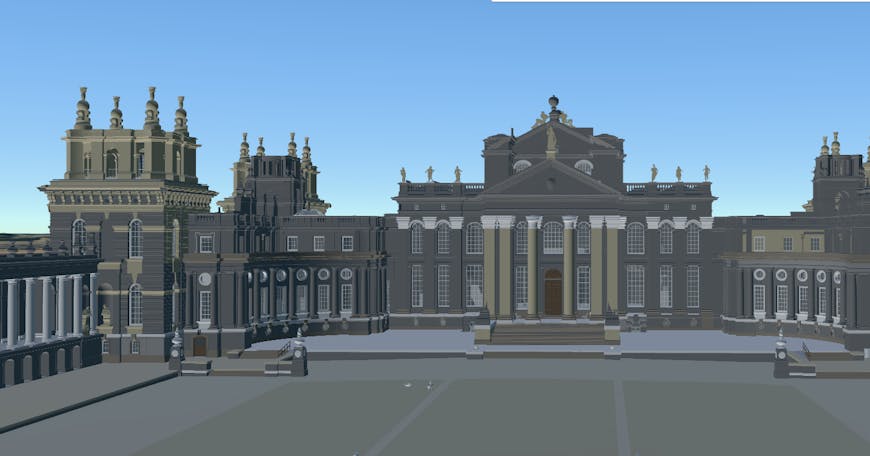
The original palace model came from a scanned point cloud, corrected by architects and tied to floor plans. Courtesy Blenheim Palace.
Simple frontend to access complex data
With the Revit model as the frontend, the palace’s intricate structure became an interactive digital twin. The model of the palace is easy to navigate, accessible to both technical and non-technical staff. Users can filter views of the site, for example, by restoration needs deemed most urgent in a recent risk assessment.
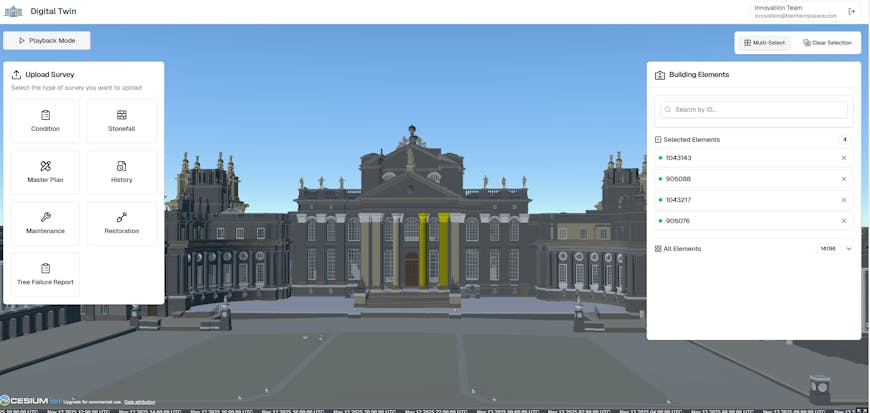
Users can filter views of the site, for example, by restoration needs deemed most urgent in a recent risk assessment. Courtesy Blenheim Palace.
Behind the interactive model sits Blenheim’s entire IoT network. By centralizing data with Cesium and automating alerts, Blenheim Palace reduced manual oversight and enabled proactive maintenance, potentially lowering restoration costs by up to 10%.
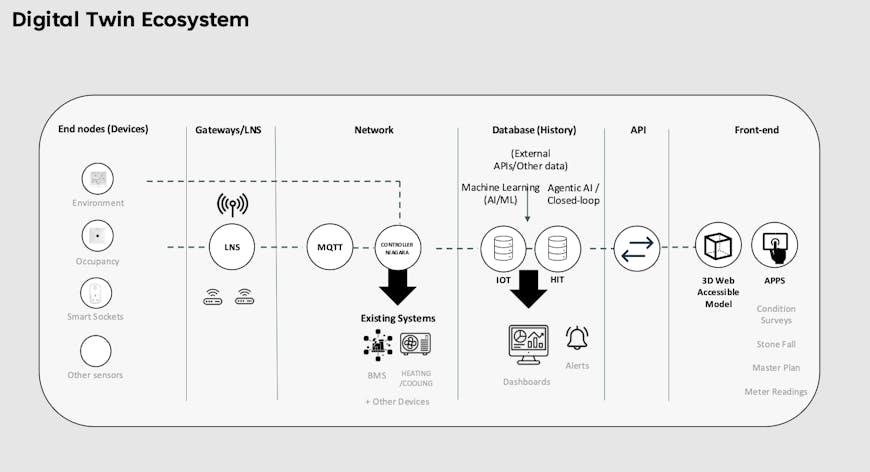
Blenheim Palace’s digital twin has a growing database currently exceeding 150 million rows of environmental and building data, fed by IoT sensors integrated with BMS controllers. Courtesy Blenheim Palace.
Predictive maintenance guided by AI insights
The digital twin also contains archival data tied to the model. This historic view, developed by Clara Saliba, makes the model a portal to the archives, giving users access to decades of maintenance history and to machine learning models trained to identify patterns in stonefall, water ingress, and exfoliation. These machine learning models are expected to enable predictive maintenance and sustainable energy use.
“Heritage isn’t just about preserving the past—it’s about imagining its future. With Cesium ion, we turned our Revit model from a virtual replica into a digital twin of Blenheim Palace—a dynamic simulation that tracks condition and restoration data, identifies inefficiencies, predicts future needs, and transforms how we manage heritage through technology.”
- David Green, Head of Innovation, Blenheim Palace
Digital insights with a purpose
The digital twin isn’t just about capturing the current state of the building. The Blenheim team is using this data to reach specific goals: Blenheim Palace aims to be carbon net zero by 2027, and a precise, real-time view into the building allows them to track energy usage and optimize systems via smart controllers to meet this ambitious goal.
"The Digital Twin at Blenheim Palace has been the flagship project for the Heritage Innovations Laboratory Oxford since its inception in 2022. As soon as we began collaborating with Cesium in the winter of last year, we began making rapid progress in pursuing our collective goals of linking heritage science and digital twinning to arrive at predictive solutions for managing built heritage environments."
- Mr. Sterling MacKinnon III, Heritage Innovations Laboratory Oxford
Future steps for the Blenheim Palace digital twin
Looking ahead, Blenheim team plans to add even more granularity to their digital twin: they’d like to slice it even further to capture more architectural details and to include household items like tapestries and furniture. They expect the model to eventually grow from its current 14,000 elements to over 50,000. In addition, they foresee being able to run frequent drone surveys of the building to provide regular updates on the state of the structure.
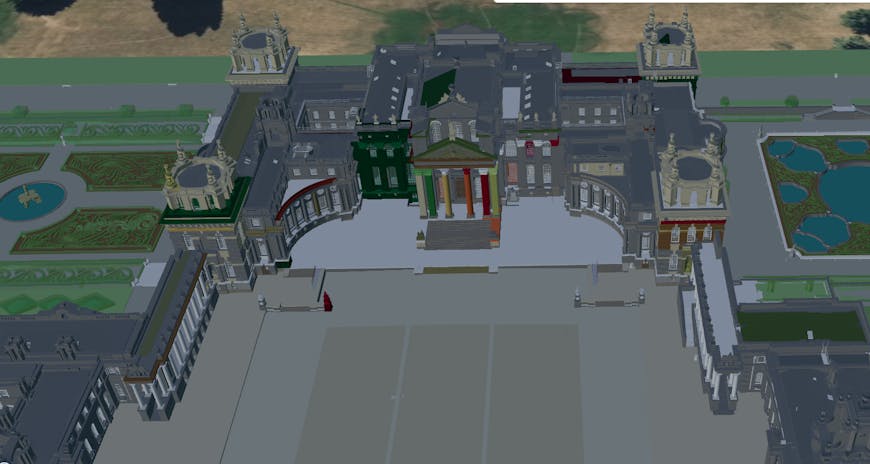
Blenheim Palace’s digital twin provides a model other heritage sites could use for smart conservation. Courtesy Blenheim Palace.
Furthering conservation globally
Blenheim’s team also built their digital twin with an eye to other heritage sites that could benefit from similar analysis. Few heritage sites around the world have the internal technical expertise that Blenheim has cultivated, and the Blenheim team has designed their digital twin to scale. They plan to develop their system into a broadly applicable platform other locations could also use, offering a model for sustainable digital conservation.
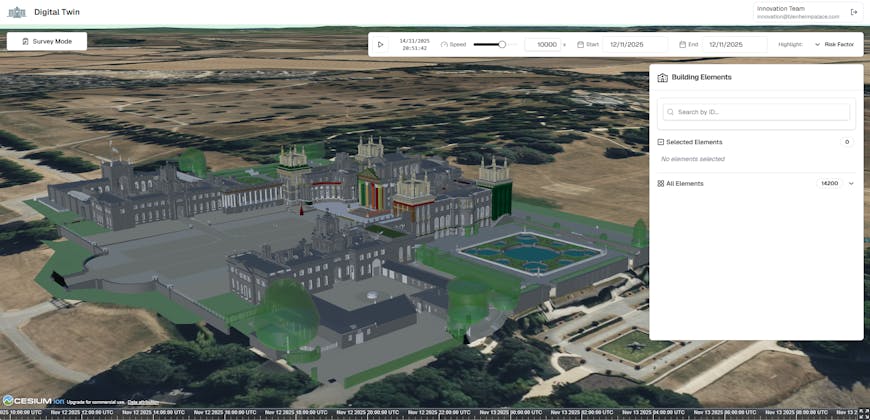
In Blenheim Palace’s digital twin, Cesium provides a spatial environment that has become the index to accessing, visualizing, and analyzing a host of data about the building. Here the palace is shown together with Cesium World Terrain and satellite imagery at its real world location. Courtesy Blenheim Palace.
To tile your own Revit models as 3D Tiles, making them streamable over the web or in runtime engines like Unreal Engine and Unity, download the add-in from the Autodesk App Store, the Cesium downloads page, or the GitHub repo.