Sandtable Modernizes and Synchronizes Military Planning with Cesium
Over the last 20 years, technology and the nature of conflict have changed more rapidly than US defense policies and military procedures. To modernize and synchronize operational-level planning, Sandtable uses CesiumJS, Cesium for Unity, and Cesium ion to combine traditional military planning documents and immersive geospatial context.
For operational wargaming in the COA analysis step of the MDMP, as well as mission rehearsal, Sandtable Navigator provides a 4D environment built with Cesium for Unity. Pictured here are friendly and enemy units at the National Training Center at Fort Irwin, California, USA. Courtesy Sandtable.
Founded in 2024 by US Army veterans and researchers, Sandtable pairs AI with human judgment in its Mentat and Navigator prototypes to facilitate mission analysis, course-of-action (COA) development, and operational wargaming with more data, detail, and speed.
Planning, collaboration, and rehearsal tools tend to involve 2D imagery, spreadsheets, printed documents, a physical sand table, and the risks that come with putting a group of key people in the same place simultaneously. The company’s push to bring time-dynamic 3D to military planning results in interactive environments that fuse data types and sources to support planning and assessment for both human teams and autonomous systems, no matter where they are.
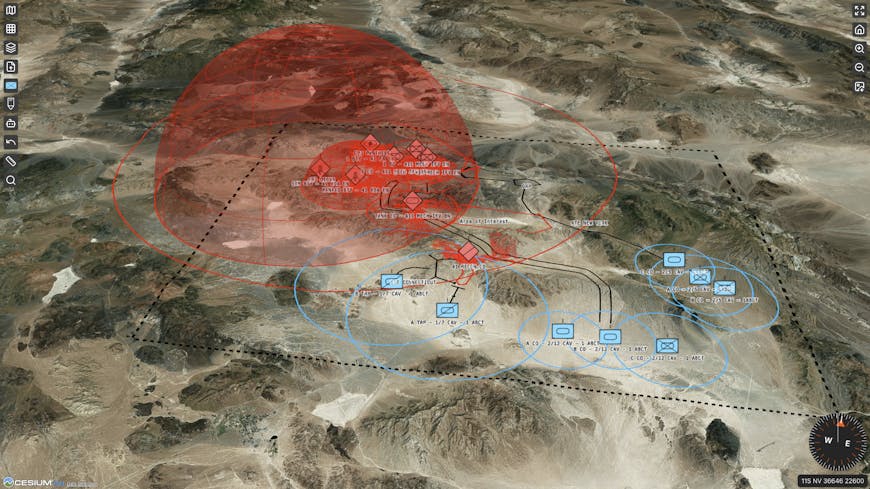
During COA DEV, planners using Sandtable Mentat create, visualize, and share unit symbology, operational graphics, viewshed, and ranges of weapon systems in 4D. Courtesy Sandtable.
“What we’re simulating and planning—like drones, counterdrone technology, and electromagnetic warfare—exists in 3D space in reality, and we need to be able to represent reality. That requires Cesium,” said Sandtable COO Brady Moore.
And reality is complex: data comes from myriad sources, and conditions shift over time. With AI, the platform helps surface patterns, compare options, and stress-test assumptions, so commanders can focus their judgment where it matters most.
Planners drag and drop MIL STD 2525D symbols from predefined combat power data to build enemy SITEMPs and friendly COAs in Mentat. Courtesy Sandtable.
Cesium is deployed across Sandtable’s solution to accelerate key phases of the military decision-making process (MDMP), particularly mission analysis, COA development, and rehearsal, with authoritative geospatial context and efficient data delivery:
- Mentat, built with CesiumJS, incorporates written orders, concept sketches, and open datasets, e.g., for soil density and composition, on top of real-world terrain in a browser for rapidly adjusting COAs with AI.
- Navigator uses Cesium for Unity for COA analysis and mission rehearsal in a shared virtual environment, wherever participants are, on a variety of devices. Instead of merely rehearsing plans produced in Mentat, Navigator feeds insights back into the planning environment—enabling continuous refinement rather than one-time execution.
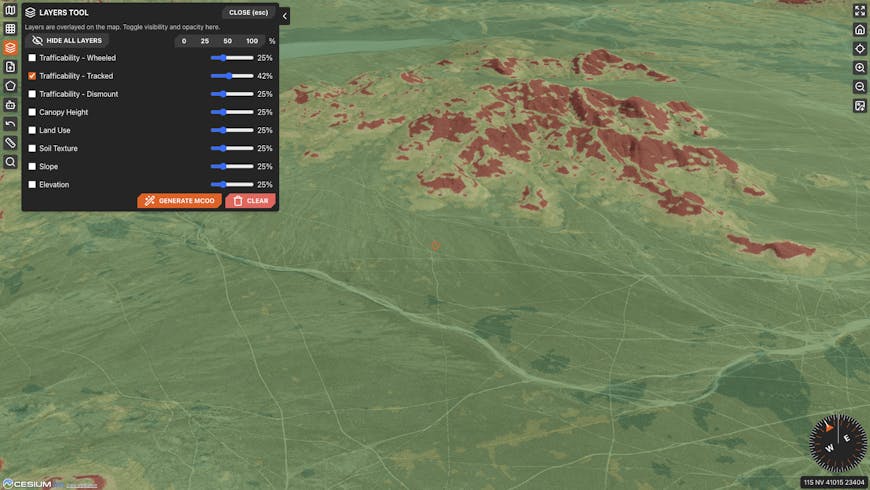
Sandtable Mentat allows planners to determine which factors about the terrain are relevant to operations and visualize them together or separately. Courtesy Sandtable.
With detailed geospatial data from Cesium ion and a range of public and government sources (for example, NOAA and USDA datasets), warfighters and autonomous vehicles know not only where hills and trees are but also microterrain features relevant to mobility and line of sight. This is important because factors like height of vegetation determine what a drone can—or can’t—see (depending on available data resolution and source quality). This data is primarily 3D Tiles, quantized mesh, and KML/KMZ, optimized, hosted, and streamed via Cesium ion for efficiency and interoperability. Cesium ion also enables Sandtable to be data agnostic, because 3D Tiles is an OGC community standard, and can use the Army's own Well Formed Format data when available. Sandtable uses Cesium ion SaaS while connected to the internet and anticipates leveraging Cesium ion Self-Hosted in future disconnected or denied environments, as well as secure enclaves.
Sandtable Mentat develops its own Modified Combined Obstacle Overlay (MCOO) using CesiumJS to visualize layers. Sandtable’s detailed datasets help determine terrain trafficability. Other terrain data includes canopy height, land use, soil attributes, slope, and elevation. Courtesy Sandtable.
Critical to Sandtable’s work is embedding with the very people who will use the platform. During the Army’s xTechOverwatch competition in October 2025, the team tested Mentat on a tablet in the field with soldiers during the day and adjusted the capabilities and interface each night, returning the next day with an improved product. Sandtable developers were able to take feedback from concept to functional visualization and analysis in hours rather than days. This speed of development is enabled by adaptable, streaming-ready 3D Tiles and open-source runtimes. (The company’s CEO, Brian Hamilton, is a Cesium Certified Developer, and Sandtable was among the competition’s winners.)
Watch Sandtable CTO Brent Lance’s 2025 Cesium Developer Conference talk to learn about the role Cesium plays across Sandtable’s solution for the MDMP.
Mentat and Navigator have been deemed Awardable on the Tradewinds Solutions Marketplace, making them eligible for government procurement and tightening collaboration between government and industry.
Use Cesium ion to securely fuse high-resolution imagery and terrain with unit-specific data for actionable information and collaboration. Get started with a community account.
Author’s note: Sandtable’s COO, Brady Moore, is a former Cesium employee.