Orbit Codex Tracks Flight of Artemis II in CesiumJS
As the Orion spacecraft journeyed around the moon during the historic Artemis II mission, space enthusiasts around the world have tracked its progress with Orbit Codex’s online flight tracker. Built on CesiumJS, the flight tracker offers an interactive 3D view of the spacecraft’s location and trajectory.
The Artemis II tracker in Orbit Codex shows the flight of the Orion spacecraft in CesiumJS using trajectory data from the JPL Horizons API.
Orbit Codex has tracked the real-time location of the Orion spacecraft from the moment of its launch using trajectory data from the JPL Horizons API. The interactive 3D capabilities in CesiumJS allow users to move forward and backward in time along the ship’s planned path, making it easy to understand orbital motion and mission phases.
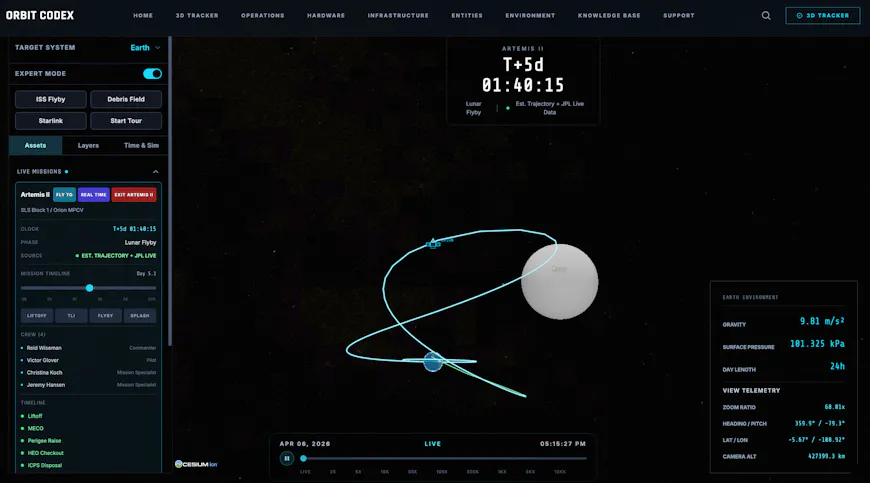
Viewing the Artemis II mission in interactive 3D makes it possible to visualize the relative motion of Earth and the Moon together with Orion’s flight path.
With roots in the aerospace industry, Cesium was designed from its inception for the high precision, time dynamic demands of space visualizations. A highly accurate WGS84 ellipsoid model of Earth and skybox with correct star and Sun positions, combined with its ability to efficiently render solar system–scale data directly in the browser makes CesiumJS the engine of choice for numerous space applications.
“Orbit Codex is a massive database of over 14,000 entities across the entire solar system, including rocket launches, over 8,000 satellites, and extensive space debris. I needed a WebGL engine capable of rendering a massive swarm of live objects smoothly. Cesium is the absolute gold standard for handling that level of scale.”
– Bret van Putten, Founder Orbit Codex
The Artemis II tracker is only one small piece of Orbit Codex. As space exploration has expanded across governments and commercial sectors, information about launches, spacecraft, and missions has become wider spread. Frustrated by the fragmented nature of space data, founder Bret van Putten harnessed his professional expertise as an AI consultant and startup founder to build a comprehensive real-time space operations platform.
Orbit Codex brings together data from dozens of sources into one unified, interactive platform that tracks launches, spacecraft, astronauts, and missions across the solar system. Data drawn from The Space Devs API is enhanced with hand curated data and a custom Google Vertex AI pipeline that uses search grounding to autonomously collect and structure historical data from verified sources.
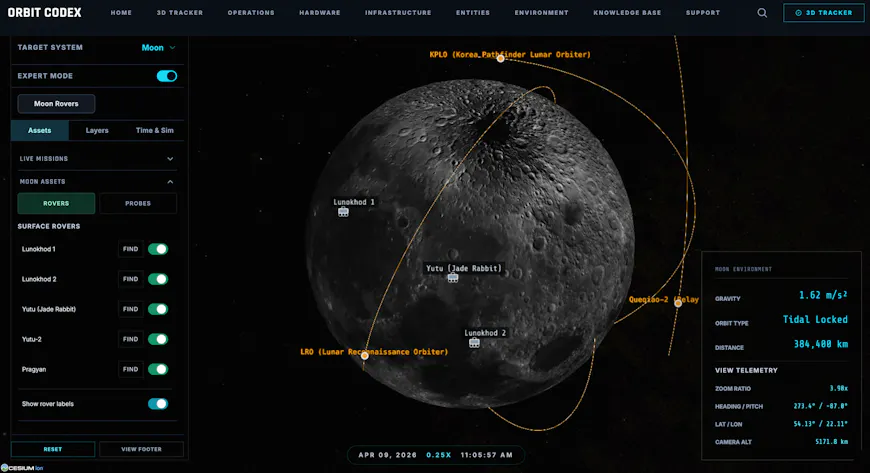
In addition to tracking the Artemis II mission, Orbit Codex uses CesiumJS to visualize numerous other activities in space. Here moon rovers are shown on Cesium Moon data. Courtesy Orbit Codex.
Across Orbit Codex, CesiumJS acts as both a visualization engine to illustrate concepts and as a spatial index for accessing the site’s datasets. Users can dive into a detailed dossier on any entity and then instantly launch into a real-time 3D environment showing a base’s launch pads, a satellite’s current orbit, or a planet’s surface.
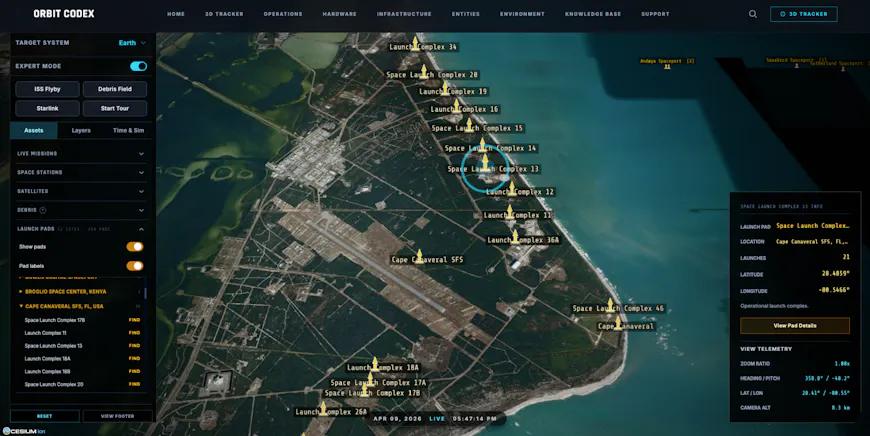
Visitors to Orbit Codex transition seamlessly between detailed information about numerous space topics and 3D visualizations in CesiumJS, like this view of the launch pads at Cape Canaveral, Florida.
Orbit Codex’s extensive encyclopedia covers 18 categories, from moonbases to rovers. Visitors can explore detailed views of more than 350 launch and landing sites in CesiumJS, read about propulsion systems, view a catalog of the more than 350 organizations working in space, and read the profiles of more than 800 astronauts. They can also track over 20,000 Earth-orbiting satellites and debris in a CesiumJS visualization that pulls TLE data from the CelesTrak and Space-Track catalogs. Space debris entries are enhanced by ESA DISCOS data describing physical properties such as mass and dimensions. Visitors will also find models of all eight planets in the solar system; Orbit Codex uses Cesium Mars and Cesium Moon for off-Earth terrain and imagery.
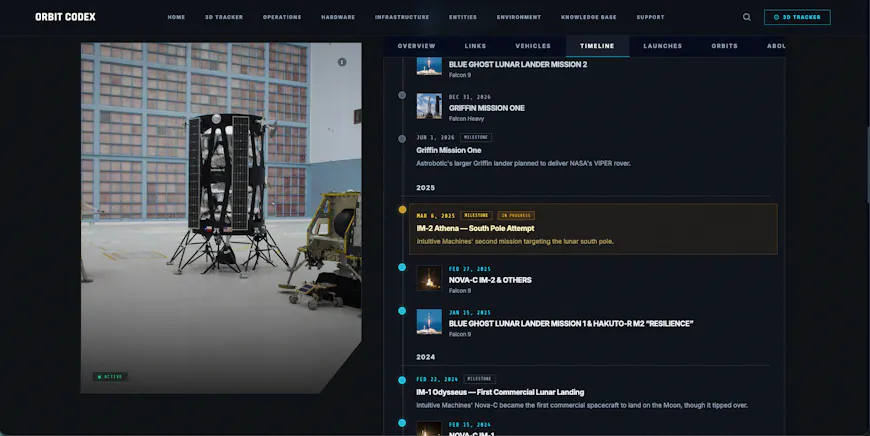
Orbit Codex is a comprehensive repository of information about space, bringing together historical and current data from public and private enterprises, as with this entry on the Athena lunar lander.
As this Artemis mission draws to a close, Orbit Codex’s journey is just beginning. The site is growing to become a “space time machine” that allows users to scrub back to 1969 to watch a replay of Apollo 11, to follow active missions from launch to touchdown, or to look ahead to future space infrastructure, such as moon bases, habitats, and space elevators.
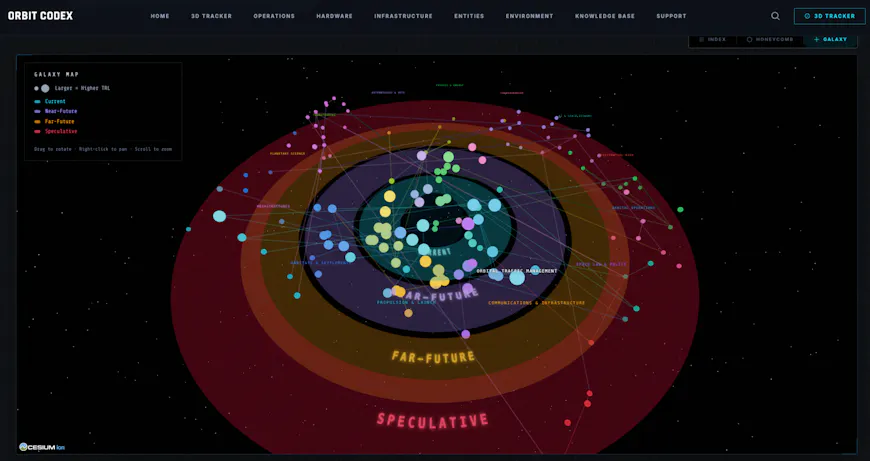
Orbit Codex points both forward and backward in time, creating an archive of past missions to space and looking ahead to humanity’s future forays into the universe.
CesiumJS provides the aerospace-grade precision and planetary scale for these ambitious plans. Sign up for your own Cesium ion account to begin developing with Cesium.