Creating an XR Connection to the E1 Series with Cesium for Unreal
The E1 Series is the world’s first all‑electric race boat championship, bringing together cutting‑edge engineering, global competition, and high-profile star power. With celebrity‑owned teams and events spanning iconic waterfronts from Jeddah to Monaco, the sport pairs high performance with high glamour. Its RaceBirds—ultralight carbon craft powered by a 150 kW electric motor and lifted by hydrofoils—slice across the water at speeds of up to 50 knots, showcasing the future of sustainable racing and raising awareness for marine conservation.
For such an innovative sport, it should be no surprise that E1 provides a premium digital fan experience, created by BADASS Studios using Cesium for Unreal.
BADASS uses Cesium for Unreal to build a digital replica of E1 race venues, which is used in live broadcasts. Courtesy BADASS Studios.
Building the scene with Cesium for Unreal
For each race, BADASS builds a precise digital replica of the venue in Unreal Engine, using Cesium for Unreal to bring in Google Photorealistic 3D Tiles, which provide an accurate, large‑scale replica of the environment. BADASS artists then add event-specific elements: waypoint markers, shoreline grandstands, and custom buildings along the route, as well as lighting and color adjustments for a vibrant look. They also place sponsorship overlays: a win-win that provides high visibility for sponsors without polluting the oceans and views with billboards or other debris.
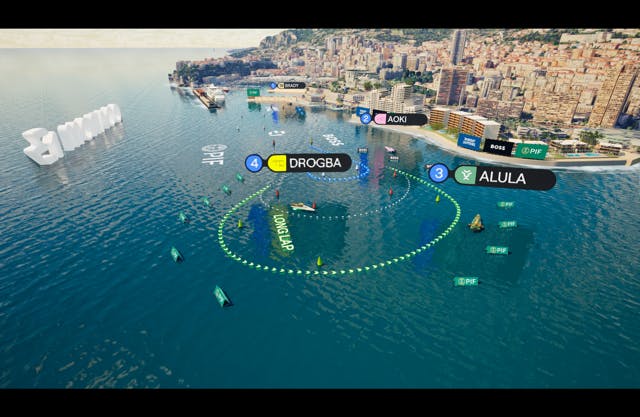
Still image of an E1 Series broadcast in Monaco. Courtesy BADASS Studios.
“BADASS operate at the intersection of creativity and technology. Their team take complex data, live telemetry and, working within the constraints of live broadcast, turn them into compelling XR experiences. They are agile, solutions-focused and deeply collaborative and have quickly become an essential extension of E1's content and product function.”
- Laurence Boyd, Chief Content and Product Officer, E1
Broadcasting the race in AR
The digital replica in Unreal provides a critical resource for live broadcasts of the race. During events, BADASS receives updates from a live telemetry feed that captures boat position, lift, trim, throttle, RPMs, and more. Their platform sanitizes the data and maps it onto the digital replica so every animation, AR label, and camera angle is synchronized with what’s happening on the water. Cesium’s geospatial accuracy means AR overlays don’t rely on tracking the broadcast feed. When the environment is removed and replaced with live video, the overlays stay perfectly aligned, enabling broadcast‑quality XR even in chaotic conditions where drone restrictions, line of sight challenges, or hardware issues can disrupt traditional filming.
With all the resources available in the Unreal environment, broadcasters can provide viewers with a visually interesting and deeply informative video by cutting back and forth between a live camera feed of the race, the digital replica in Cesium for Unreal, and a hybrid AR view of the race with data on the RaceBirds’ telemetry.
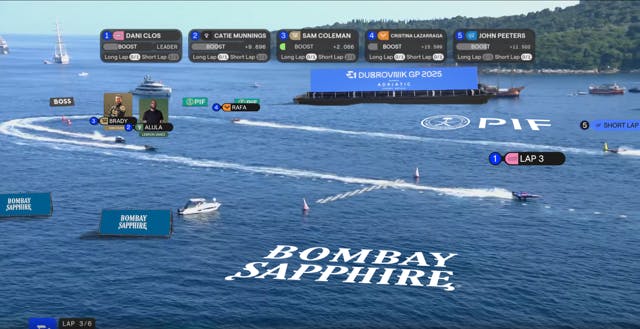
BADASS provides AR overlays for broadcasts of races, like this race in Monaco. Courtesy BADASS.
Enhancing the experience with VR
The Cesium replica of the race isn’t just for broadcasts. Fans who come to watch the E1 Series can also take part in the races themselves in a game simulator. Players pick a team and a RaceBird and try their hand at piloting through the course, using the same environment BADASS built in Cesium for Unreal to use in course explainers and live broadcasts of the race. For onsite attendees, these simulators fill downtime between races and deepen engagement. In the future, these environments will also be published as a game on Steam and other platforms, allowing fans to play at home.
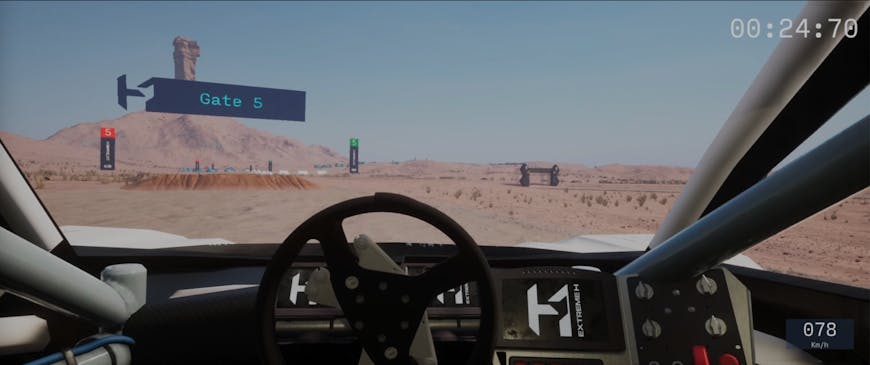
BADASS Studios reuses the same Cesium for Unreal race venue for VR and AR broadcasts and for simulations. They bring their adaptable approach to multiple live events, as shown in this simulation of the FIA Extreme H World Cup in Qiddiya City, Saudi Arabia. Courtesy BADASS Studios.
Expanding reach
This multi-use approach—creating a single environment that can be reused in marketing, broadcasting, and games—is only possible because of Cesium’s geospatial accuracy and streaming efficiency. Such reusable content deployed in so many ways simplifies the process for E1, which can solve many needs with a single digital twin, and for BADASS, which maximizes the use of the assets it builds.
In addition to the E1 Series, BADASS Studios supports a number of events, including the FIA Extreme H World Cup, an off-road race of hydrogen powered SUVs, and FIM World Supercross Championship. With a scalable platform built on Cesium, they plan to expand into other sports and entertainment live events, giving viewers in any location an enhanced connection to real events.
To build a geospatially accurate environment you can deploy in numerous ways, try out Cesium for Unreal.